


Birding With Nate — January Bird of the Month: Northern Flicker
Birding with Nate
January Bird of the Month: Northern Flicker

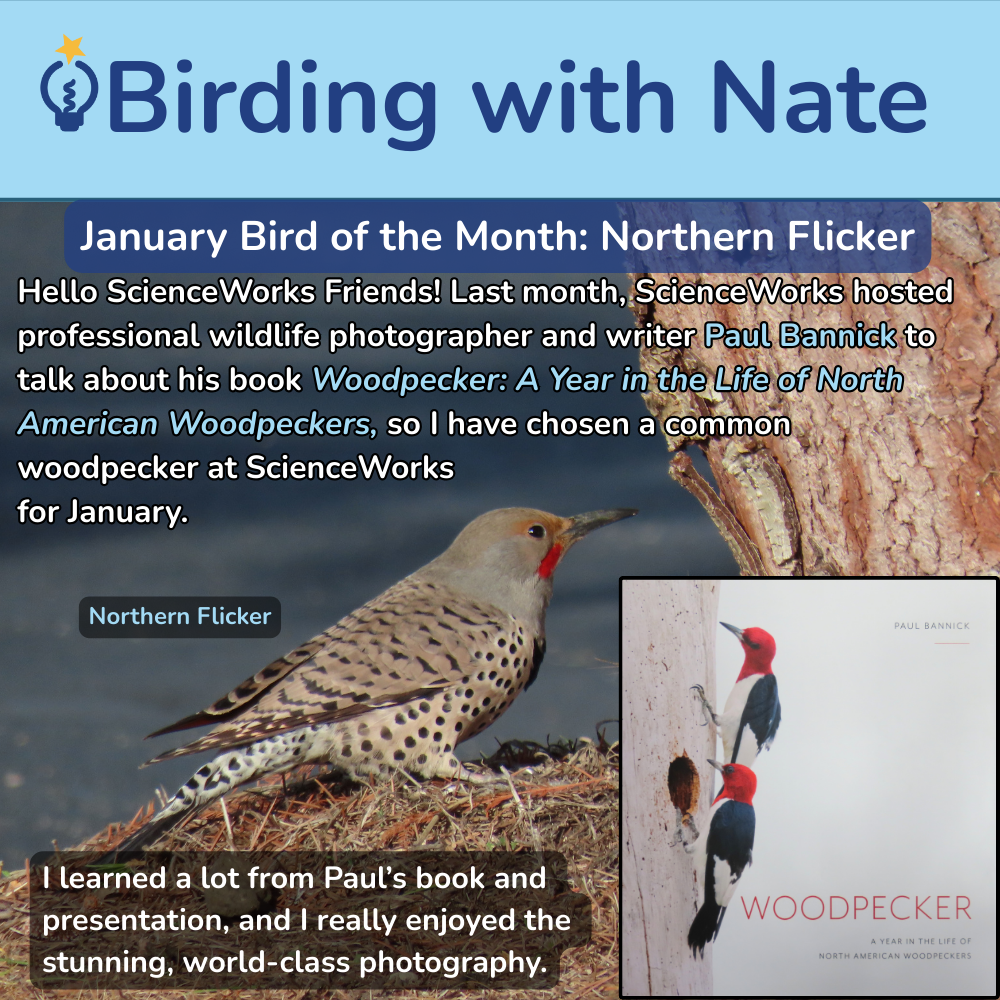


Hello ScienceWorks friends!
Last month, ScienceWorks hosted professional wildlife photographer and writer Paul Bannick to talk about his book Woodpecker: A Year in the Life of North American Woodpeckers, so I’ve chosen a common woodpecker at ScienceWorks for January. I learned a lot from Paul’s book and presentation, and I really enjoyed the stunning, world-class photography.
Northern Flickers are spectacular animals. They have bold facial markings, black half-moon chests, polka dot or heart-shaped spots covering their fronts, and bright, colorful underwings and tails.
Flickers are very common across a wide variety of habitats in Southern Oregon and throughout North America. Northern Flickers come in two distinct color morphs: the red-shafted variety, common in the West, and the yellow-shafted form, more common in the East. Males of both morphs have fancy mustaches. I found this pair at Blue Heron Park in Phoenix. The male is showing off his bright red-orange (red-shafted) feathers on the underside of his tail.
Most Northern Flickers in Southern Oregon are of the red-shafted form, which has bright orange-red underwings and tails, and males with red mustaches. Yellow-shafted Flickers have bright yellow underwings and tails and black mustaches instead of red. Male yellow-shafted Flickers also have red chevrons on the backs of their heads.
Interestingly, hybrids are regularly found. This one I found in Ashland is a hybrid and shows characteristics of both color morphs. The Northern Flicker is one of two woodpecker specimens on display inside ScienceWorks. Can you tell which color morph he is?
Flickers are less “woodpecker-like” than other Oregon woodpeckers. They are shades of tan and gray instead of the usual black, white, and red, and they spend more time on the ground than other woodpecker species. Flickers use their long bills and tongues to feed on ants and other insects on and under the ground. Their ability to find ants on the ground allows them to thrive in many open and semi-open woodlands, absent only from the densest forests and most treeless grasslands. They are also common in suburban spaces. This guy is foraging in the landscaping in the ScienceWorks parking lot.
These birds aren’t shy about using human structures as perches. They like to use the top of my metal woodstove chimney as a territorial drumming surface, rattling my whole house like a tiny jackhammer. They choose prominent perches to belt out their loud “KEOW” calls and “KEK KEK KEK KEK KEK” songs. Flickers definitely let you know they’re there.
Birders love spotting rare and hard-to-find birds, but one thing I love most about flickers is how common they are. They’re big, colorful, loud, and all over our neighborhoods and parks. I see and hear these birds almost everywhere I go in Southern Oregon. For me, Northern Flickers are a daily reminder of just how beautiful the world is if we take a bit of time to look. Listen for their far-reaching calls, and watch for them bounding through the air while flashing their bright orange underwings and white rumps.
Happy Birding!
And don't forget to add your own bird sightings to the ScienceWorks eBird Hotspot!
Related Articles